Position paper (preprint) · July 2026
Canonics
Vigency in AI Memory After Judgment Expires
33 pp. · 14 figures · CC BY 4.0
Facts expire visibly. Judgment loses force silently.
Version the frame, not the facts.
Your second brain has a slow leak. We call it the second drain.
01Opening claim
Every AI memory system can tell you whether a fact is still true. Canonics asks whether a stored judgment is still in force.
The agent is not hallucinating. It is citing obsolete judgment.
The paper proposes that long-lived agent memory needs a way to record when the regime that made an interpretation authoritative has been replaced, so that the interpretation remains on record as history without continuing to guide action.
02Legal analogy
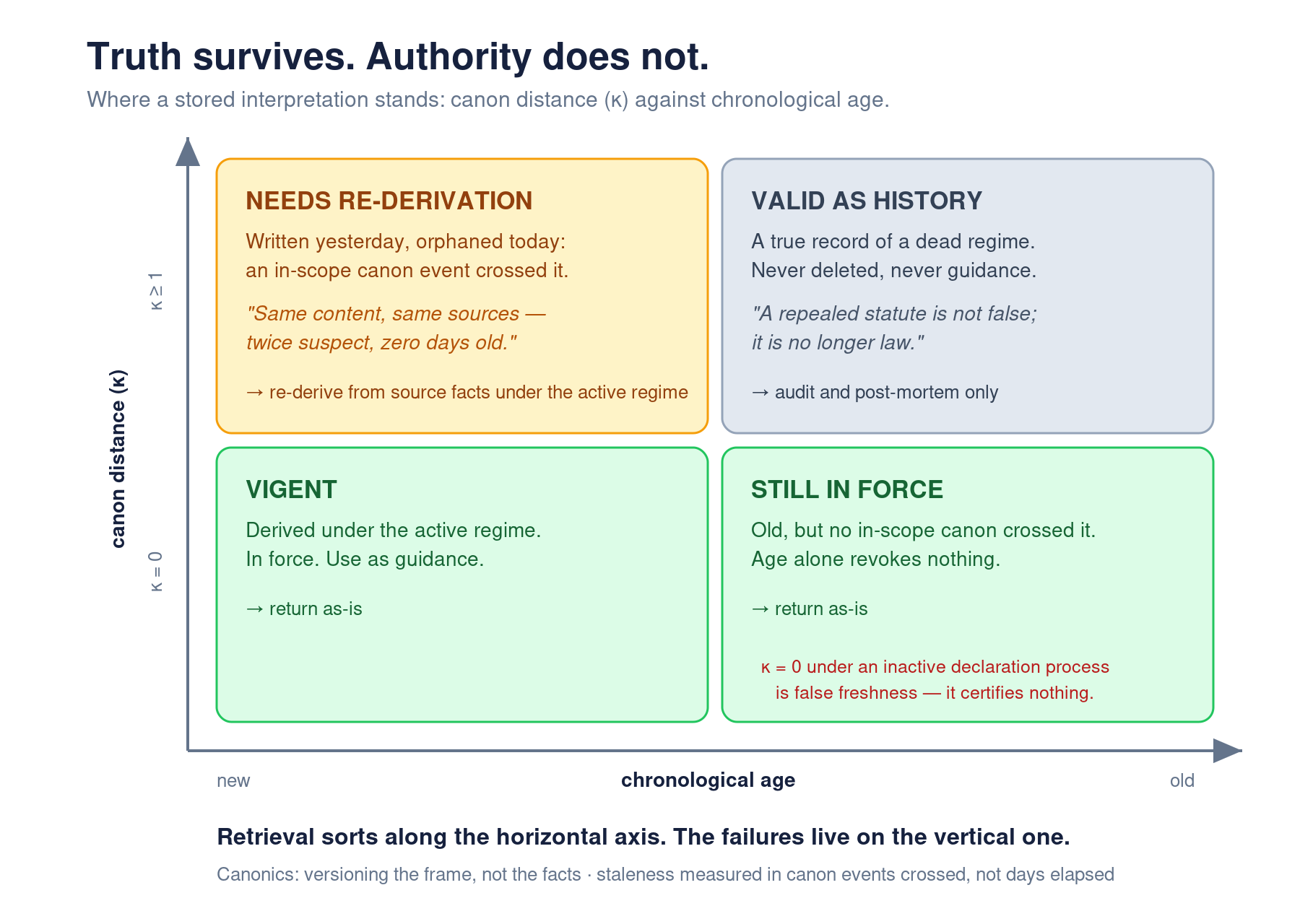
In law, a repealed statute does not become false. Its text remains on record, but it no longer governs. Canonics brings that force-versus-truth distinction into long-lived AI agent memory.
Old knowledge is not deleted. It stops governing.
Facts remain immutable; derived understandings are versioned and re-derived from source facts rather than overwritten.
03Core vocabulary
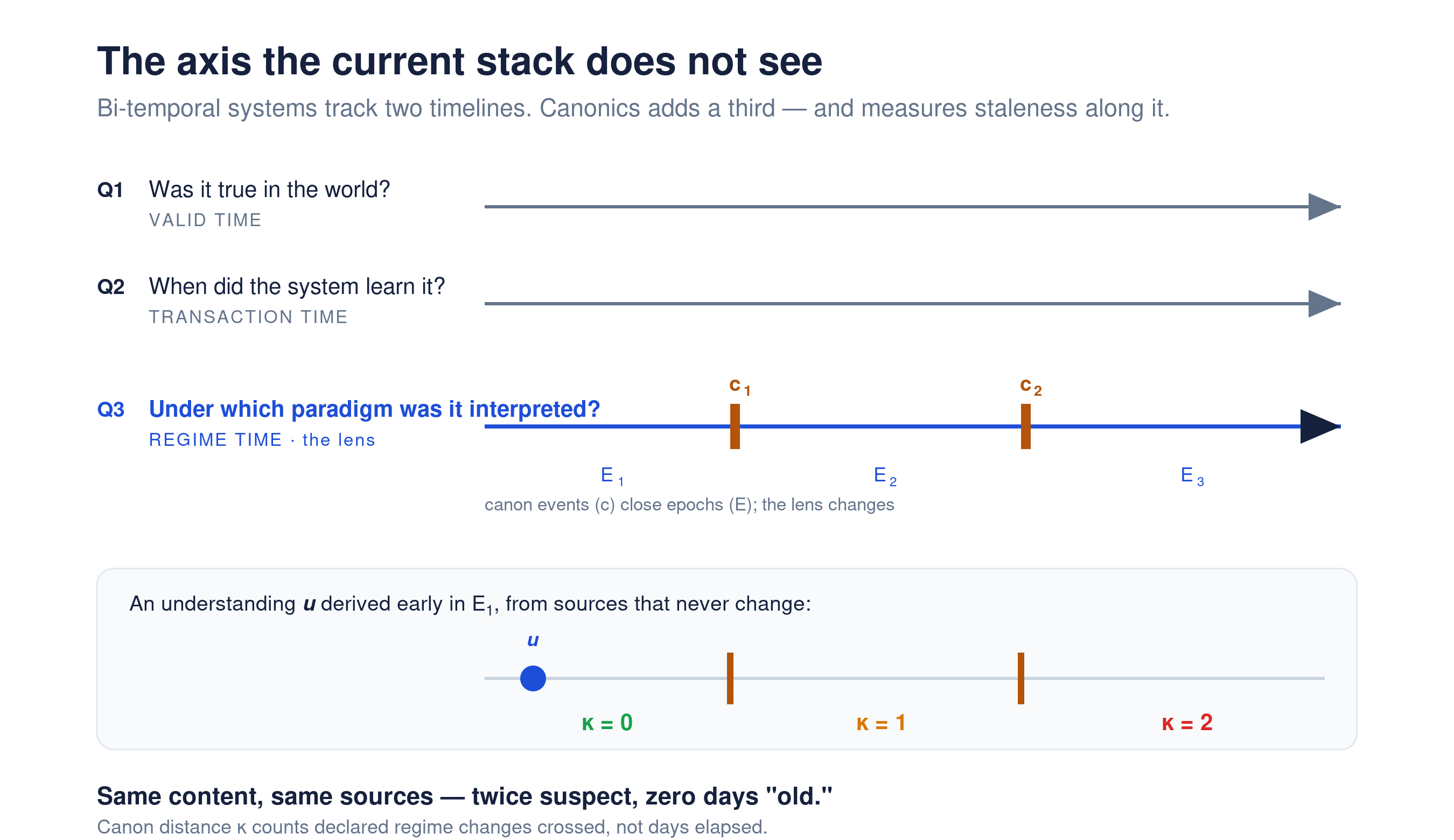
- Canonical vigency
- Whether an interpretation remains in force under the active canon.
- Canon event
- A human-declared change to the interpretive regime, with explicit scope. Canon events are not inferred by the machine.
- Epoch
- A per-domain regime interval derived from canon events.
- Canon distance (κ)
- The number of in-scope canon events crossed since derivation.
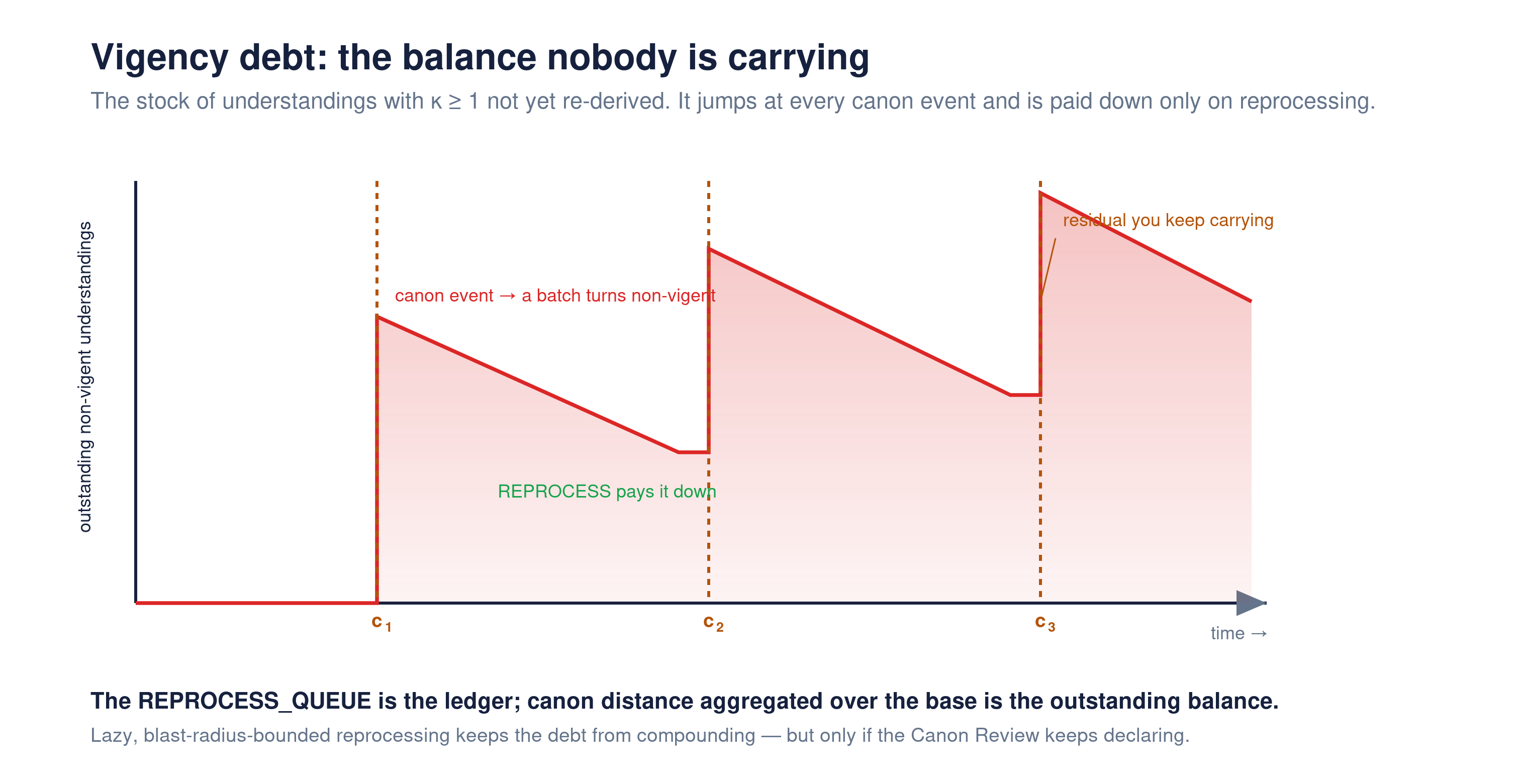
- Vigency debt
- Non-vigent understandings not yet re-derived, revoked, or quarantined from guidance.
- Canon Review
- A recurring protocol where machine scanning attempts to falsify active canons and a human adjudicates.
“Second drain” is an informal hook for the failure pattern, not a technical primitive.
04Figures
05The Two-Tag Wedge (one sprint)
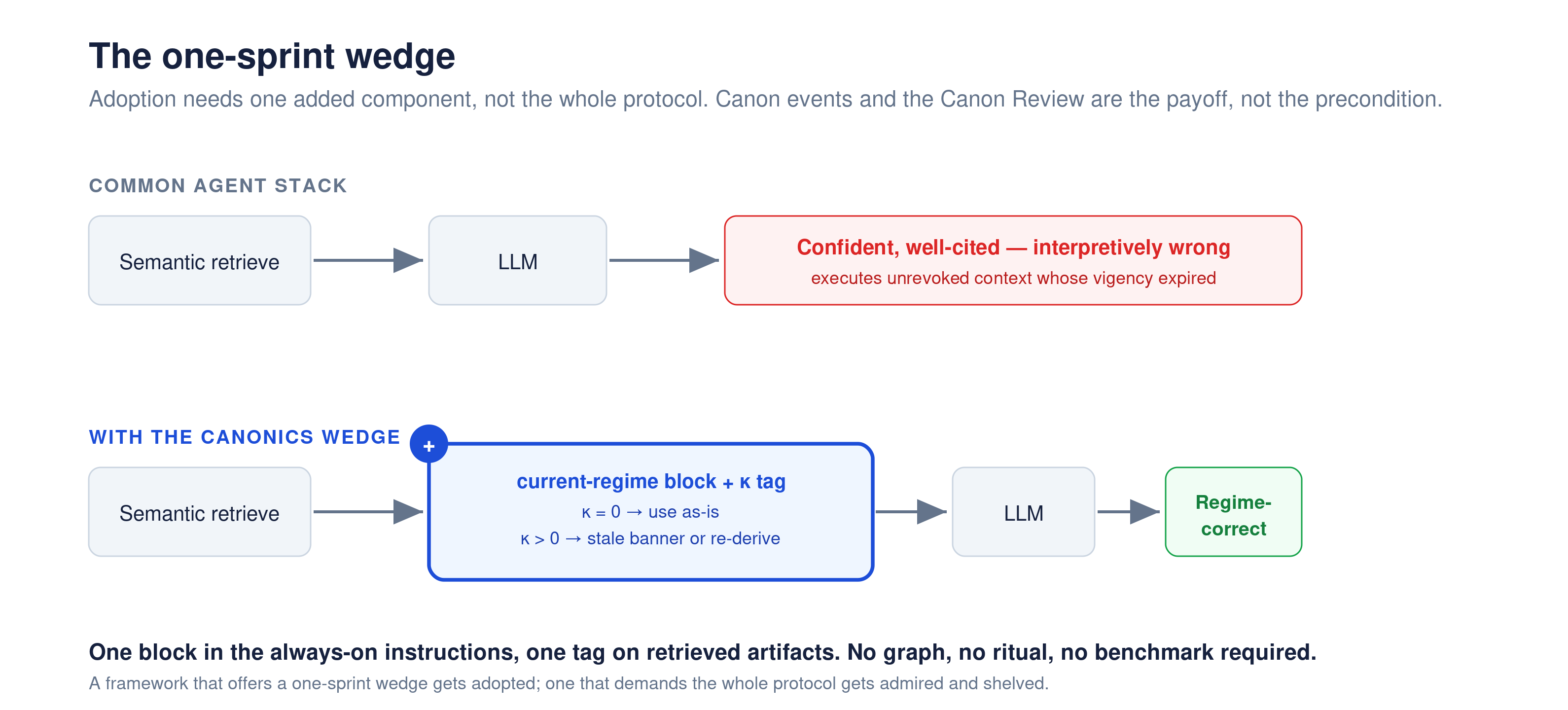
- Keep a current-regime block in the agent's always-on instructions.
- Attach an
epoch_id/canon_distancetag to retrieved derived artifacts. - Use κ = 0 normally. On κ > 0, show a stale-regime banner or route to re-derivation.
The wedge is a proposed minimal adoption slice, not a measured return on investment. κ = 0 certifies nothing when the declaration process is inactive.
06Non-claims
- Canonics does not detect silent regime change automatically.
- κ is not a validity certificate.
- Reprocessing is machine-proposed and policy-activated.
- scope is a single operator or small high-trust team.
- Markdown+Git is a substrate, not the invention.
- The paper is a position paper, not an empirical-results claim.
Comparisons with existing memory systems in the paper are framing arguments from the author, not verified empirical findings.
07Artifacts
- Position paper (preprint) · July 2026
- Repository README
- Executive brief
- Specification
- VRS benchmark spec
- CLI scaffold
- Skill source
- Quickstart
- Agent-readable summary
08Citation
33 pp. · 14 figures · CC BY 4.0
@misc{amorim2026canonics,
  title        = {Canonics: Versioning the Frame, Not the Facts — Vigency in AI Memory After Judgment Expires},
  author       = {Amorim, Lucio},
  year         = {2026},
  month        = jul,
  howpublished = {Preprint},
  note         = {Position paper (preprint), July 2026. NXLV Research},
  license      = {CC BY 4.0},
  doi          = {10.5281/zenodo.21268307},
  url          = {https://doi.org/10.5281/zenodo.21268307}
}DOI: https://doi.org/10.5281/zenodo.21268307
Author ORCID: https://orcid.org/0009-0001-3323-9152
09Contact
Lucio Amorim, NXLV Research, Rio de Janeiro, Brazil · lucio@nxlv.ai
Comments on the position paper are welcome.
The field already knows how to version facts. Canonics versions the frame.