Canonics
(formerly the Canon–Epoch Framework, CEF)
"Version the frame, not the facts: interpretive-regime versioning for long-lived AI agent memory."
facts are immutable; interpretations are versioned cache; canon events are the invalidation signal; epochs are the cache key; the Canon Review is the scheduled audit of the invalidation signal itself.
Canonics in 60 Seconds
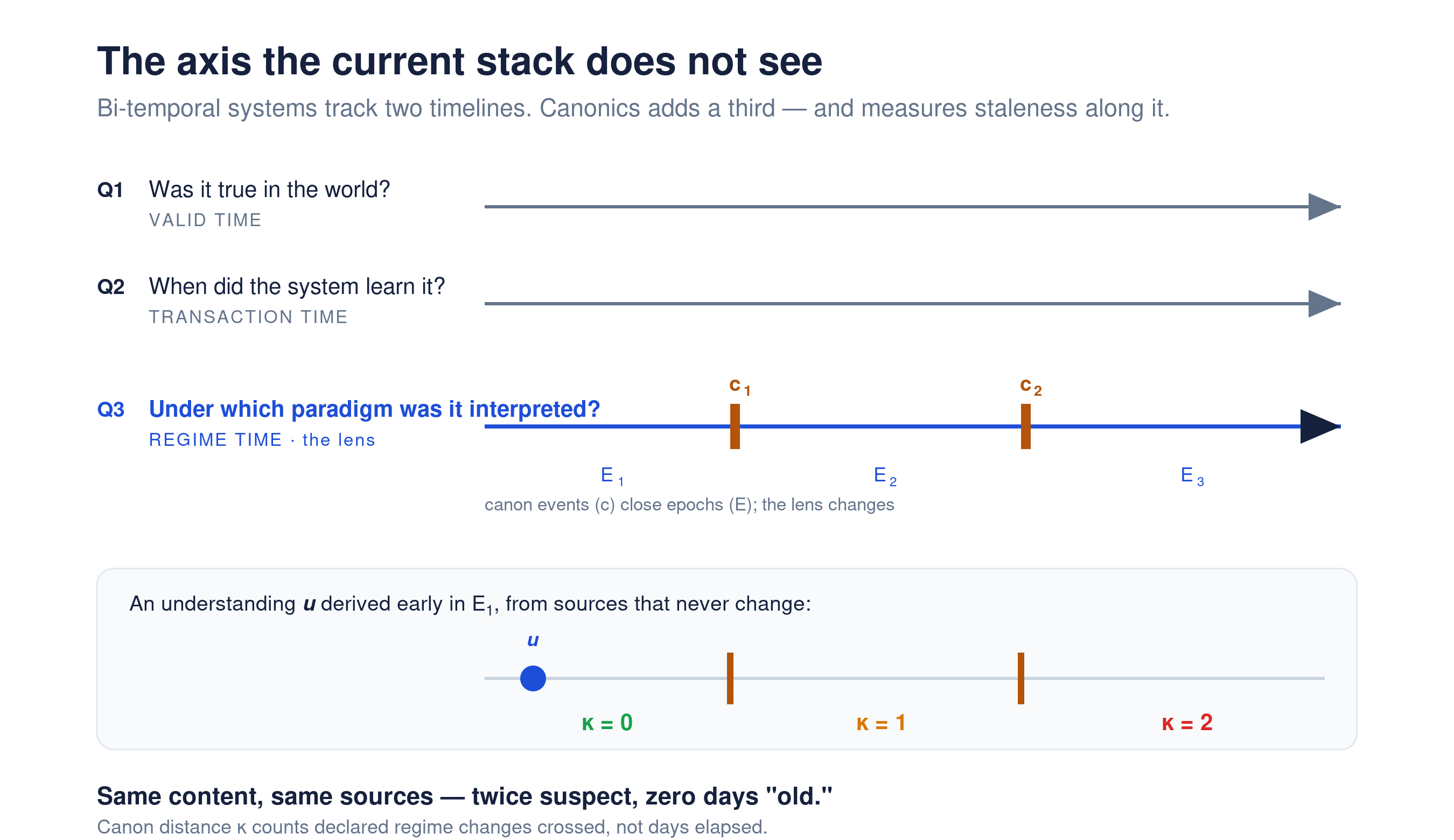
Agent memory fails when it retrieves true records from dead regimes. Canonics adds repeal to long-lived memory: facts remain immutable, interpretations are stamped with the regime that authorized them, and canon events mark when that authority changes. The result is not automatic drift detection. It is a governance layer for deciding which remembered judgments still have force.
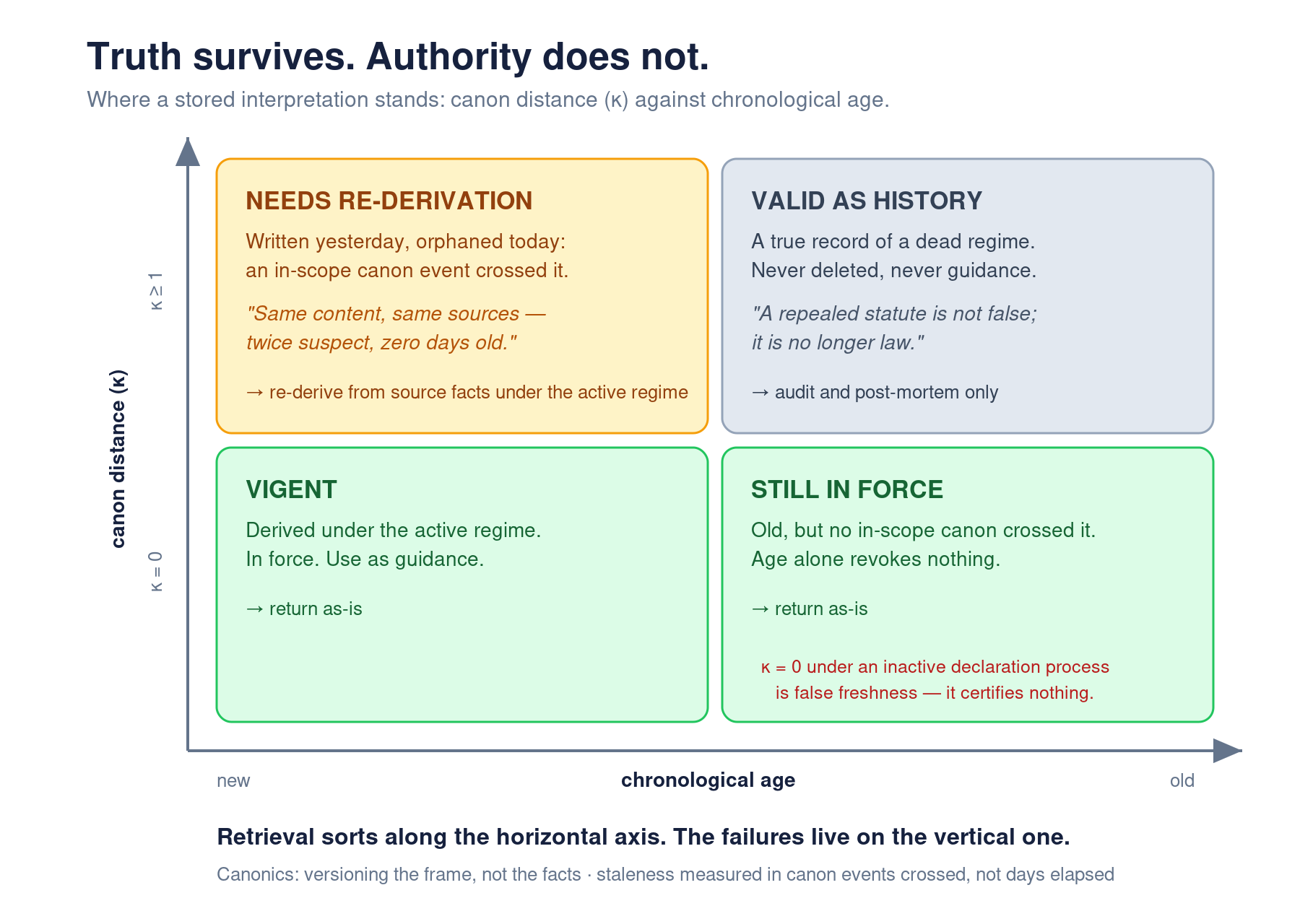
Every second brain tends to become a second drain: it consumes ambient maintenance and returns confident answers from a world that no longer exists. The failure is subtle because the agent sounds grounded: it is not hallucinating -- it is citing obsolete judgment.
Canonics, by Lucio Amorim, versions the interpretive regime under which long-lived agent memory is read. It composes established components -- event sourcing, bi-temporal modeling, context logics, belief revision -- into what is, to our knowledge after targeted prior-art review, the first framework for LLM-agent memory that operationalizes the interpretive regime itself as a versioned, human-declared object with scoped propagation and source-based re-derivation. Canonics governs canonical vigency — whether a derived interpretation is still in force under the active canon, as distinct from whether its source facts are still true.
canon_event:
  id: C-2026-07-VA-solo
  t_effective: 2026-07-03
  t_declared: 2026-07-03
  declarer: operator@venture-a
  level: L3
  diff:
    retires:
      - "Delivery team available"
      - "Delegation is the primary scaling mechanism"
    introduces:
      - "Solo operator; capacity bounded by the operator alone"
      - "Automation and asset creation are the primary scaling mechanisms"
  blast_radius:
    domains: [venture_a]
    secondary: [personal_finance]
    assumption_categories: [delivery_capacity, pricing_model, project_selection, delegation]
Before Canonics, a pricing query can retrieve a March pricing model because it is semantically relevant, even though it was derived under the team-delivery epoch. With Canonics, the same understanding is retrieved with canon distance (kappa) = 1 -- a distance to declared marks, not a validity certificate -- because one declared in-scope canon event crossed its epoch of origin; RETRIEVE triggers REPROCESS from source facts under the solo-operator regime, and because pricing is critical, the new version enters as proposed until human adjudication.
What Canonics Does Not Do
- Canonics does not detect regime shifts autonomously. It reduces the cost of declaring and propagating regime shifts once perceived, and structures and measures perception through the Canon Review.
- Canon distance (kappa) is a distance to declared marks, not a validity certificate. kappa = 0 under an inactive declaration process certifies nothing.
- Reprocessing is machine-proposed and policy-activated. Critical domains remain human-gated.
- The scope is a single operator or small high-trust team. Multi-stakeholder authority and enterprise access control are future work.
- The Markdown+Git substrate is a convenience, not the concept.
- Operational viability is a falsifiable hypothesis, not demonstrated fact.
- Canonics does not eliminate maintenance; it compresses and schedules it.
- Canonics is not a second brain and does not compete with capture tools. It governs the interpretation of what other systems capture.
The Two-Tag Wedge (one sprint)
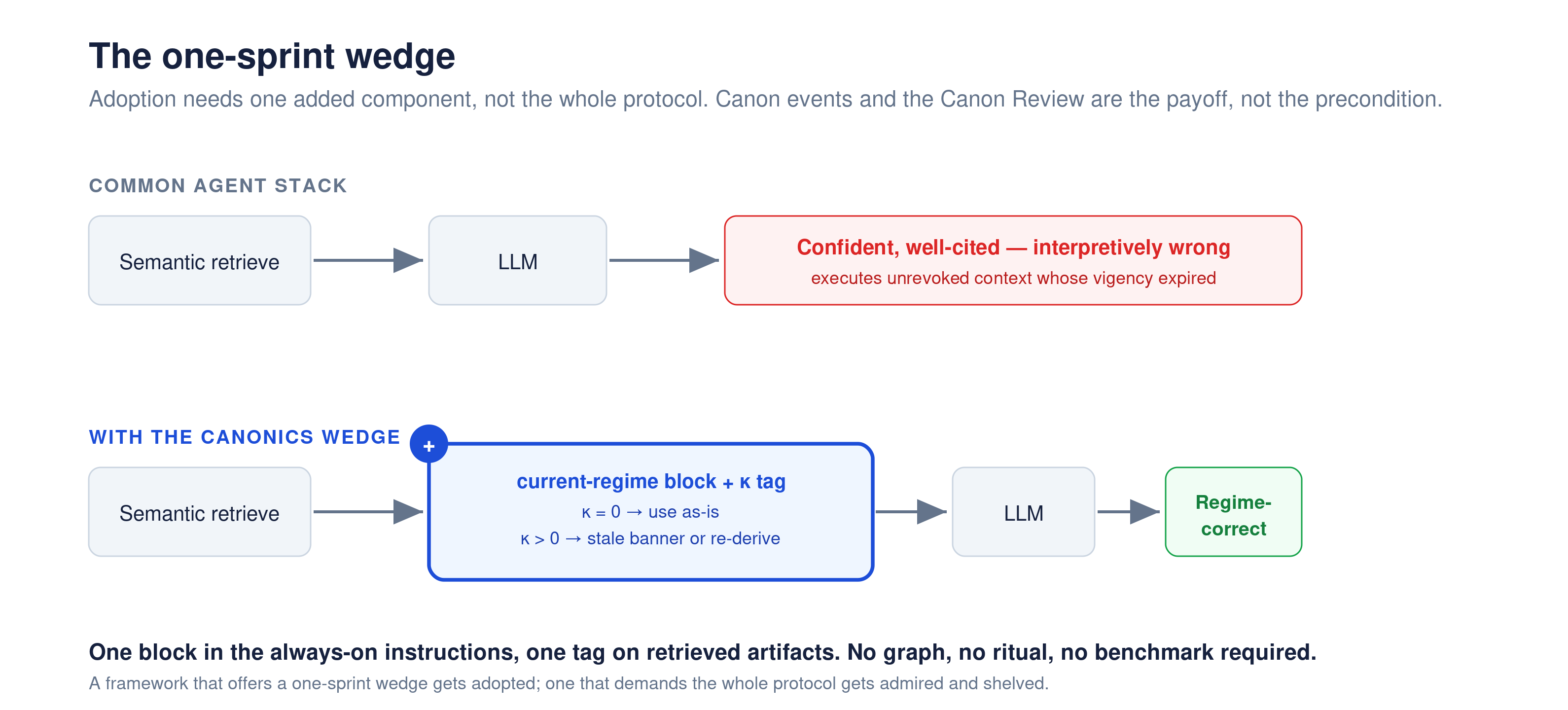
Adoption does not require the whole protocol. Canon events and the Canon Review are the payoff of adopting Canonics, not the precondition — the minimal slice, named the Two-Tag Wedge, pays for itself in a single sprint and takes two moves:
- Keep a current-regime block in the always-on instructions (system prompt /
CLAUDE.md/AGENTS.md) — not in retrievable storage, because retrieval-visible updates are frequently ignored by models even when plainly in context. - Attach an
epoch_id/canon_distance(κ) tag to every retrieved derived artifact. Then: κ = 0 → use the artifact normally; κ > 0 → show a stale-regime banner (or trigger re-derivation) instead of presenting it as current guidance.
That's it — no graph database, no vector store migration, no benchmark required to start. A framework that offers a one-sprint wedge gets adopted; one that demands the whole protocol upfront gets admired and shelved. If you build agent tooling and want the technical name: this is regime-aware retrieval, minimal form.
See Quickstart for the full walkthrough (zero to first canon event in 15 minutes), which builds on this wedge with the complete DECLARE/RETRIEVE/REPROCESS/SCAN cycle.
Likely Objections, Routed
| Likely objection | Short answer |
|---|---|
| "This is just document versioning." | Versioning preserves history; Canonics governs the authority of interpretation. A repealed statute is not an old draft. |
| "This is just factual staleness." | A stale fact loses truth; a non-vigent interpretation loses force. Different failure, different repair: re-derivation under the active regime, not correction by a newer fact. |
| "This depends on humans noticing drift." | Yes — by design. Canonics does not promise autonomous detection; it governs declaration, propagation, and audit once a shift is perceived, and instruments the noticing (the Canon Review). |
| "This is just prompt engineering." | A prompt changes one local instruction; a canon event changes the shared interpretive regime — one declaration, every agent, every in-scope derived understanding. |
| "This won't scale to the enterprise." | Correct, and stated in the paper (§11.5): scope is a single operator or small high-trust team. Enterprise authority models are the named research agenda. |
Start Here
The GitHub repository is not public at the moment. The documents linked here are supplied reference materials, not a public repository installation.
- Quickstart: zero to first canon event in 15 minutes.
- Specification — Position paper (preprint) · July 2026: normative primitives, operations, schemas, Canon Review, and Canon Integrity.
- Conformance: RFC 2119 requirements for conforming deployments.
- Reference implementation: convenience substrate using Markdown+Git.
Status: Position paper (preprint) · July 2026 + reference spec; operational-sustainability hypothesis (H-G) under longitudinal test.
Repository License
Code, schemas, commands, and reference-implementation materials are licensed under Apache-2.0. Documentation under docs/ is licensed under CC BY 4.0; see docs/LICENSE.
How to Cite
If you use this framework, cite the position paper:
@misc{amorim2026canonics,
  title        = {Canonics: Versioning the Frame, Not the Facts},
  author       = {Amorim, Lucio},
  year         = {2026},
  month        = jul,
  howpublished = {Preprint},
  note         = {Position paper (preprint), July 2026. NXLV Research},
  doi          = {10.5281/zenodo.21268307},
  url          = {https://doi.org/10.5281/zenodo.21268307}
}
Author ORCID: 0009-0001-3323-9152. Machine-readable citation metadata (CFF) is maintained in CITATION.cff at the repository root; the repository is not public at the moment.